
Why 73% of Indian B2B Deals Are Lost Before Your Sales Team Even Knows They Exist — And How Domain Intelligence Closes the Dark Funnel Gap
Q1: What is the "dark funnel" in Indian B2B sales, and why should sales leaders care in 2026?
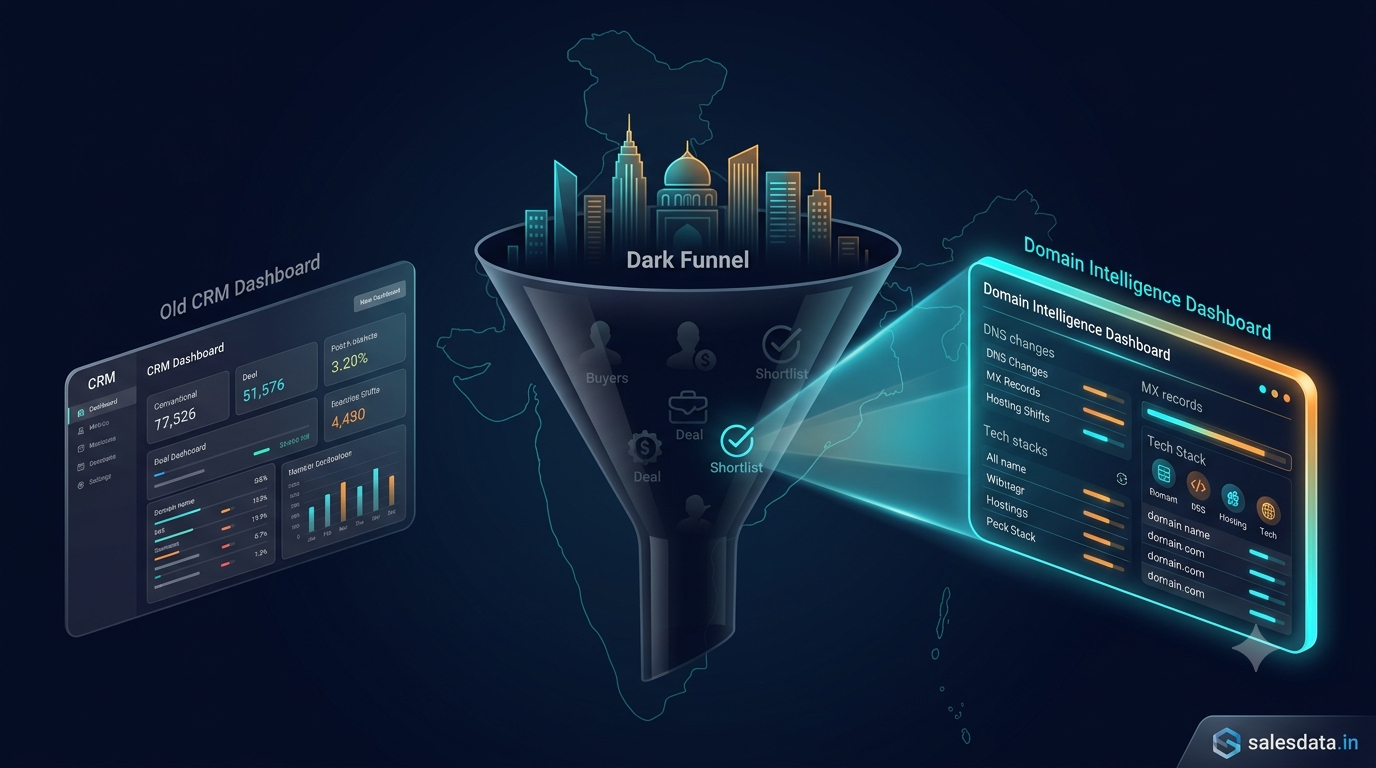
The dark funnel is every buyer activity that happens before a vendor is contacted — and that no CRM, analytics platform, or attribution model can see. In India, 73% of enterprise B2B buying decisions are made before a vendor is contacted, meaning the pipeline your sales team is fighting to close was actually won or lost in a window your CRM never captured. According to 6sense research, 83% of B2B buyers fully define their purchase requirements before ever speaking with a sales team, and Gartner's 2025 research found that buyers complete 70 to 80% of their purchase journey before engaging a vendor representative at all. For Indian B2B companies, this creates a specific problem: most go-to-market investment is concentrated in the visible funnel — outbound prospecting, conferences, referral relationships — while almost nothing is invested in the pre-funnel window where shortlists are quietly built in WhatsApp groups, Slack communities, and LinkedIn DMs.
Q2: Why do Western sales intelligence tools fail so badly in India's mid-market?
ZoomInfo, Apollo, and Lusha were built for a world where companies have strong English digital footprints and executives maintain polished LinkedIn profiles. Indian mid-market companies ($10M–$250M revenue) operate differently — they are often owner-operated, family-run, or regionally focused, and their leaders rarely maintain up-to-date LinkedIn profiles. India has 63 million registered businesses in the MCA registry, and most have no LinkedIn presence at all. The architecture of these tools is contact-centric: they index profiles from professional networks and supplement with firmographic databases. A senior SDR manager targeting Indian manufacturing told us: "Apollo shows me a handful of contacts, but I know from market visits there are hundreds of firms with the same revenue. The data just isn't there". This isn't an accuracy issue — it's a coverage gap built into the design of static databases.
Q3: What signals does a domain emit that a contact database cannot capture?
Domain intelligence flips the model. Instead of indexing people, it indexes domains and the signals they emit: DNS changes, hosting shifts, email authentication updates, technology stack additions, traffic patterns, and infrastructure expansions. These are real-time, structurally sound signals that do not depend on whether a founder in Surat has a LinkedIn profile. A domain that suddenly deploys a new e-commerce stack, changes its MX records, or migrates to enterprise-grade CDN infrastructure is telling you something — before any form fill, before any UTM parameter, before any CRM entry. The technographic data market grew from $367 million in 2020 to more than $1 billion in 2026, riding a roughly 26 percent annual growth rate, precisely because these signals outperform static contact data for timing and fit.
Q4: How does a domain intelligence dashboard change a sales team's daily workflow?
It shifts the team from chasing stale contacts to reading live infrastructure signals. Instead of asking "Who should I call?" the question becomes "Which domains are showing buying activity right now?" A domain intelligence dashboard enriches every new lead with traffic, ranking, backlink data, and inferred signals like email provider, DNS provider, and SPF/DMARC presence — all in one automated workflow. This is particularly powerful in India, where business decisions are relationship-led and buyers lean on personal networks and industry WhatsApp groups to shortlist vendors before any sales contact happens.
Q5: What does India's sales intelligence market look like in 2026, and where is it heading?
The India Sales Intelligence Market was estimated at USD 830 Million in 2025 and is projected to reach USD 1,184 Million by 2032, growing at a CAGR of 6.1%. Around 40% of surveyed companies are already using marketing or sales intelligence tools for prospecting, and roughly 50% of small businesses not currently using them have cited plans to adopt in the near future. The dominant tools remain contact-centric and Western-designed — creating a structural opening for an India-first domain intelligence approach that captures what static databases structurally cannot.